Stratify Insights
Built from AI Capital Risk Research
The AI Capital Risk Instrument (ACRI)
Structured methodology for AI capital authorization decisions
The AI Capital Risk Instrument (ACRI) is a structured evaluation methodology used to assess structural readiness before organizations authorize AI deployment capital.
Research-led methodology delivered as a board-ready AI Capital Risk Report in approximately 14 days.
AI Capital Risk is the risk of approving AI investment before an organization is ready to deploy it at scale, resulting in potential capital impairment.
Produces a capital authorization posture:
Pause · Controlled Investment · Authorize Deployment
Built on category-defining research for boards and investment committees evaluating $1M - $10M+ AI investments.
AI Capital Risk Framework
Five-vector framework used to evaluate structural exposure before AI capital authorization.
Deterministic Evaluation
Rule-based instrument producing reproducible capital authorization determinations.
Board-Level Deliverable
Board-ready AI Capital Risk Reports used in governance and investment committee decisions.
14-Day Evaluation
Structured AI capital exposure evaluation delivered within approximately two weeks.
Why AI Capital Decisions Are Increasingly Risky
Organizations are committing significant capital to AI initiatives while governance frameworks, regulatory obligations, and operational execution capabilities remain uneven across organizations.
Without a structured evaluation of these exposure conditions, boards and investment committees often approve AI capital without a defensible understanding of risk.
The AI Capital Risk Instrument (ACRI) was developed to evaluate these exposure conditions before AI capital is authorized.
Common exposure drivers include:
- unclear governance accountability for AI systems
- regulatory classification risk under emerging frameworks such as the EU AI Act
- fragile data pipelines and infrastructure dependencies
- organizational execution constraints during deployment
- misaligned capital allocation assumptions
When Stratify Is Used
Organizations typically run the instrument when boards are preparing an AI capital authorization decision.
AI Capital Authorization
A major AI deployment is under consideration and leadership needs a clear AI capital authorization basis before committing funds. Stratify delivers a board-ready AI capital risk report for that decision window.
Private Equity Portfolio Deployment
Operating partners need a consistent AI risk assessment approach across portfolio companies. The instrument provides comparable AI governance risk and execution exposure signals.
Regulatory Exposure Evaluation
Organizations evaluate EU AI Act exposure before launch in regulated markets. The output highlights whether capital deployment can proceed under current controls.
How the AI Capital Risk Instrument (ACRI) Works
Step 1
AI Initiative Proposed
Business units propose an AI deployment initiative involving automation, decision models, or operational optimization.
Step 2
Exposure Evaluation
The AI Capital Risk Instrument (ACRI) evaluates governance, regulatory readiness, infrastructure reliability, organizational execution capability, and capital discipline.
Step 3
Capital Authorization Determination
ACRI produces a deterministic capital authorization posture: Pause, Controlled Investment, or Authorize Deployment.
Step 4
Board Investment Decision
Directors and executive teams use the AI Capital Risk Report to inform capital authorization decisions.
Preview the AI Capital Risk Report
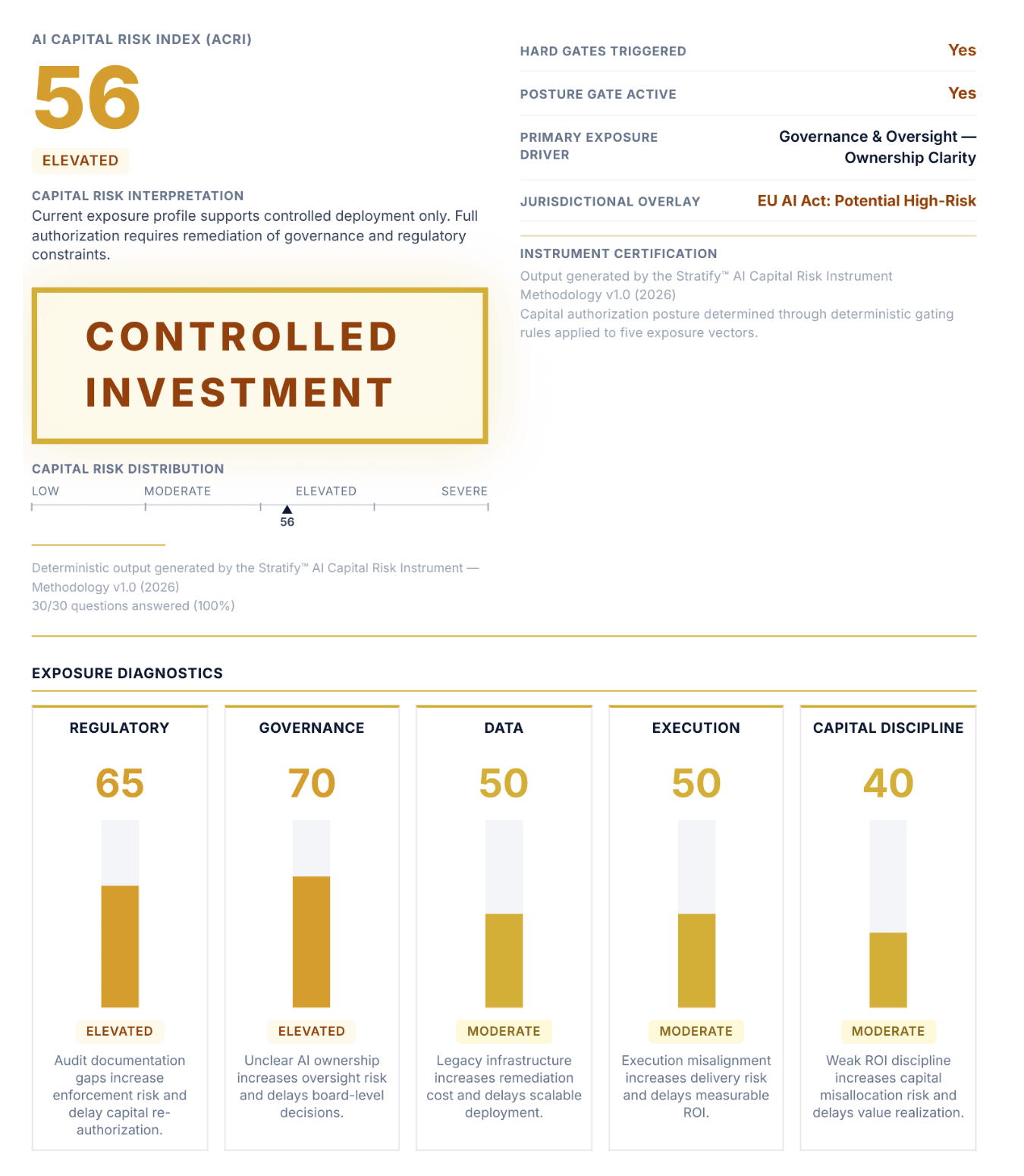
Stratify produces a board-ready AI capital risk report with an AI Capital Risk Index score, vector exposure diagnostics, capital authorization determination, EU AI Act exposure mapping, and a deployment stabilization roadmap.
Executive Determination Output
Example Executive Determination output showing AI Capital Risk Index score, capital authorization posture, and vector exposure diagnostics generated by The AI Capital Risk Instrument (ACRI).
Evaluate Your AI Capital Exposure
A short executive diagnostic to identify whether your organization may face structural AI capital risk before approving investment.
Estimated completion time: approximately 60 seconds.
Exposure Signal
Complete all five questions to view your AI capital exposure signal.
Trusted in Capital Authorization Decisions
The AI Capital Risk Instrument (ACRI) supports board and investment committee decisions by evaluating AI deployment exposure before capital is approved.
Board-Level Governance
Boards use Stratify to evaluate governance readiness, regulatory exposure, and execution conditions before authorizing AI capital deployment.
Private Equity Investment Committees
Investment committees apply the instrument across portfolio companies to support disciplined AI capital allocation decisions.
Regulated Industry Oversight
Regulated operators use Stratify to evaluate governance controls and regulatory exposure before AI systems are deployed into production environments.
The Capital Risk Framework
A concise AI risk assessment framework focused on AI capital risk and AI capital authorization decisions.
Regulatory & Compliance Exposure
Regulatory classification risk and documentation readiness.
Structural Governance & Oversight
Accountability structures and oversight for AI deployment.
Data & Infrastructure Fragility
Reliability and scalability of AI data pipelines.
Organizational Execution Risk
Operational capability to deploy and monitor AI systems.
Capital Allocation & Value Realization
Investment governance and ROI tracking for AI initiatives.
Capital Authorization Outcomes
Pause
Deployment should not proceed until governance, regulatory, or operational exposure conditions are remediated.
Controlled Investment
AI deployment may proceed within defined governance and operational guardrails.
Authorize Deployment
Exposure conditions support broader AI deployment under continued governance discipline.
Who Stratify Is For
Private Equity Firms
Evaluate portfolio AI capital authorization decisions with a consistent exposure framework.
Mid-Market Operating Companies
Assess AI governance risk and operational readiness before approving major AI investment.
Financial Services Institutions
Evaluate regulatory exposure and control sufficiency before scaling AI in decision systems.
Typical Engagement
Typical AI capital evaluated
$1M – $10M+
Stratify evaluation
$18,500 fixed fee
Delivered in approximately 14 days.
Portfolio engagements available.
Research & Framework Development
The AI Capital Risk Instrument (ACRI) was developed from AI Capital Risk research to evaluate structural exposure conditions associated with AI capital deployment.
The framework synthesizes governance, regulatory, operational, and capital allocation signals that commonly determine whether large-scale AI deployments succeed or fail.
Rather than evaluating individual models or vendor solutions, The AI Capital Risk Instrument (ACRI) evaluates the organizational conditions required to support AI capital deployment at scale.
The Capital Risk Framework underlying ACRI evaluates five structural exposure dimensions:
- governance
- regulatory readiness
- infrastructure reliability
- organizational execution capability
- capital allocation discipline
The evaluation methodology is deterministic and version-controlled, allowing organizations to reproduce results and trace posture determinations to specific input conditions.
The current evaluation model is documented as Capital Risk Framework — Methodology Version 1.0.
Evaluate Your AI Capital Exposure
Request an executive briefing to review AI capital risk, AI governance risk, and the capital authorization determination pathway for your planned deployment.
Typical Stratify engagements
- organizations evaluating $1M – $10M+ AI capital deployments
- board or investment committee authorization decisions
- engagement completed in approximately 14 days