You can't put AI on a spreadsheet.
Not when the spreadsheet is the process.
Critical work still runs across spreadsheets, inboxes, and internal apps nobody can maintain. Before you automate it, the work needs to become a system.
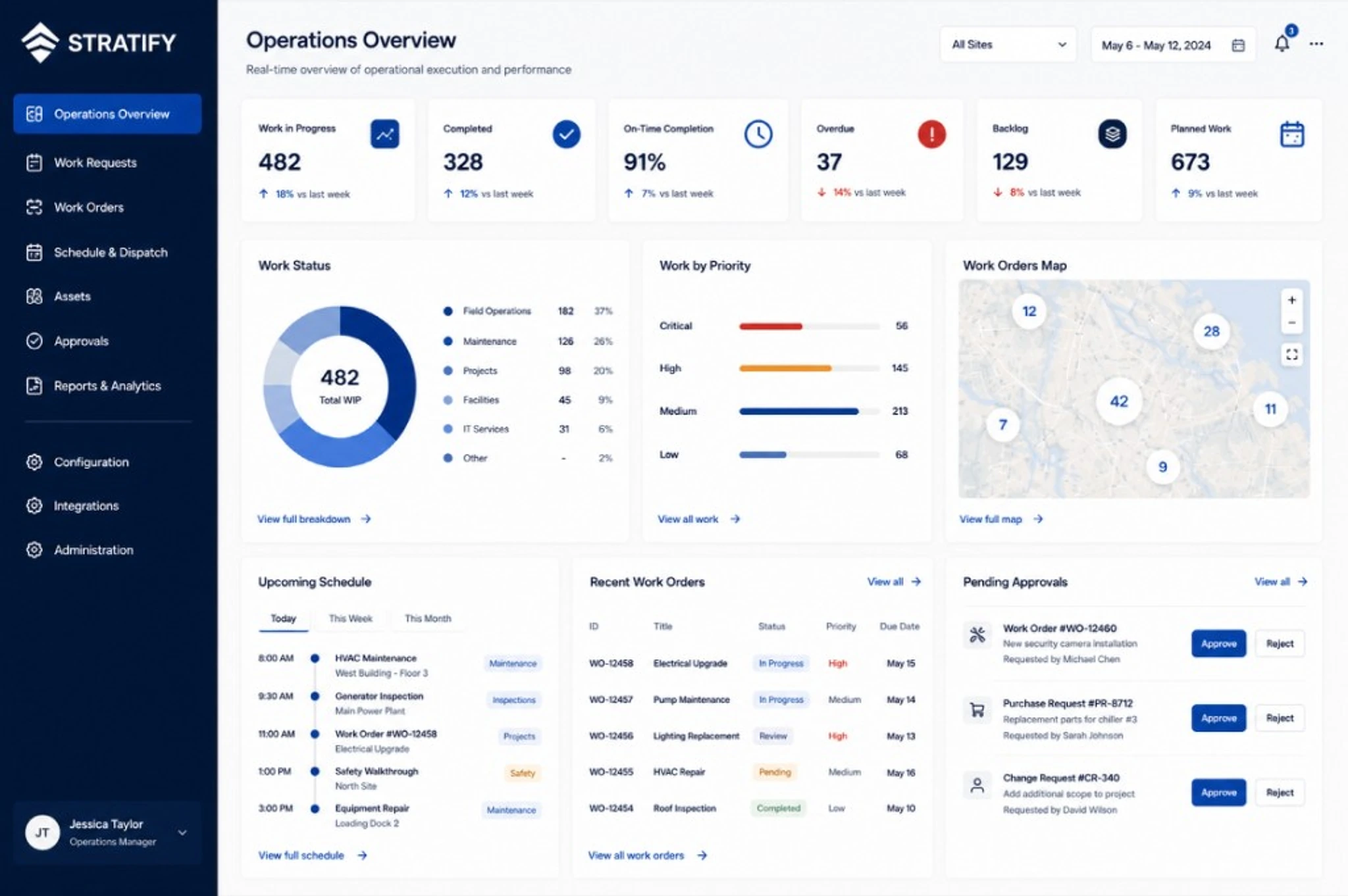
Stratify rebuilds those processes into operational software in weeks, not quarters.
01The problem
The foundation was always the hard part. It just stopped being the expensive part.
For years, rebuilding an operational process meant a software project: requirements, consultants, development, integrations, six months, twelve months, sometimes longer.
So companies made a rational compromise. They ran important processes in spreadsheets, email, shared drives and aging internal applications, and increasingly tried to layer automation and AI on top. A copilot here. A summarizer there. Another integration.
The underlying process never became a system.
That calculation has changed. Stratify can take the process you already have and turn it into working operational software without starting a traditional software project: structured intake, routing, decisions, approvals, exceptions, status, history.
The process becomes visible. And once it's visible, you can improve it.
Today
- The spreadsheet everyone edits
- The inbox used as a workflow
- The internal app nobody maintains
No structure. No state. Nothing reliable to measure.
As a structured operational system
- 01Structured intake
- 02Routing
- 03Decisions
- 04Approvals
- 05Exceptions
- 06Status
- 07History
Working operational software, not a workaround and not a traditional software project.
02The process
Show us the process that's creating the most friction.
You don't need a requirements document. Show us what exists today: a screenshot, a spreadsheet, an internal application, even the inbox people are using as a workflow.
We'll show you how that process can operate as a real system.
The spreadsheet that runs an important process.
Everyone depends on it. Nobody really owns it.
The internal app nobody wants to touch.
It works, until something needs to change.
The shared inbox that's actually a workflow.
Requests arrive, people forward them, and status lives in someone's head.
The process where "what's the status?" requires a meeting.
The information exists. The system doesn't.
The promise, stated precisely: Show us the process. We'll show you what it looks like as a system.
A real operational system gives you four things.
Structured intake
One front door. Requests arrive complete and in a known structure instead of scattered across emails, spreadsheets and conversations.
Explicit decisions
The system knows who reviews what, what evidence they need, what criteria apply, and what happens next.
Captured state
Every item has a current state. You know where it is, who owns it, what it's waiting for, and how long it has been there.
Recorded outcomes
What happened remains attached to the work: what was decided, by whom, why, when, and what happened afterward.
None of that is AI.
It's the foundation AI needs to become useful. But you don't have to wait for AI to get the value. Once the work becomes visible, companies often discover problems they couldn't see before.
03The result
They didn't have a $4.28M sales problem. They had a visibility problem.
A commercial lighting manufacturer was running production across QuickBooks, spreadsheets, and an internal application nobody could maintain.
Stratify rebuilt the operational process in Flow in weeks, while leaving financial operations in QuickBooks untouched.
When the work became visible, the system surfaced something immediately:
$4.28M
in awarded work blocked from moving forward.
Nobody was hiding it. Nobody had failed to run a report. The existing process simply couldn't show it.
04Flow
Replace the workaround. Keep what already works.
Stratify Flow doesn't require you to replace your ERP, accounting system, or other systems of record. It fills the operational gaps between them: the spreadsheet everyone edits, the approval chain living in email, the production tracker that doesn't connect to anything, the internal application nobody can maintain.
Flow turns that work into software built around the way the operation actually runs.
Typical processes
Production and job tracking · Service requests · Operational approvals · Customer and member intake · Exception management · Internal requests · Multi-step reviews
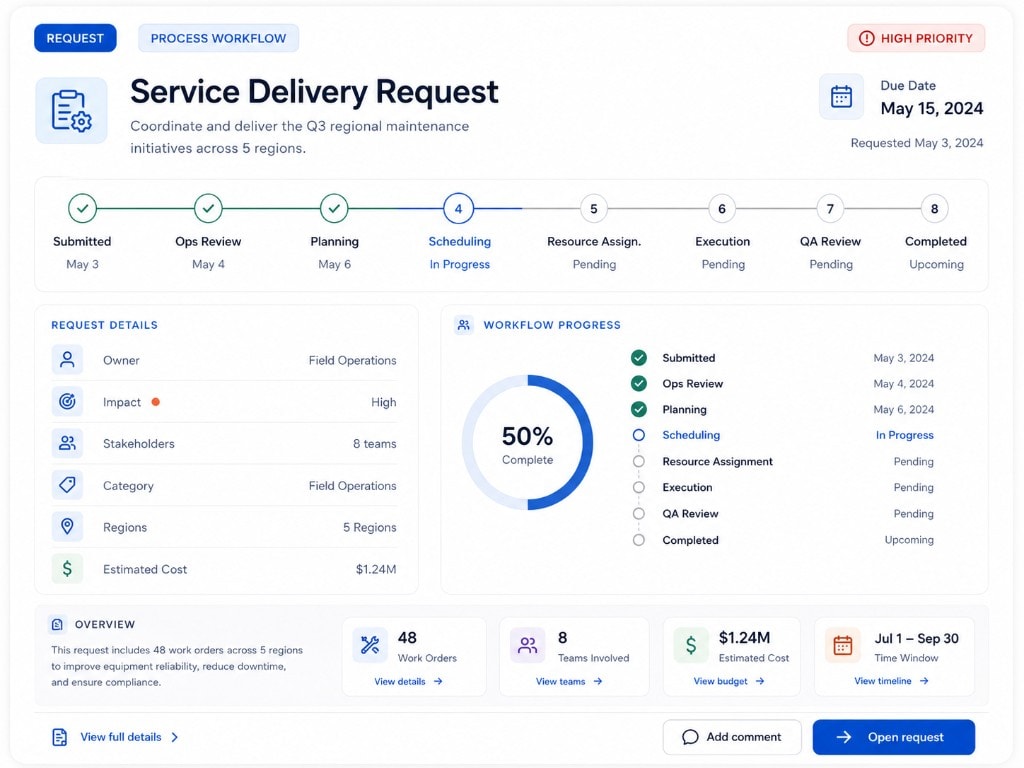
Current status · Owner · Process stage · Exceptions · Approvals · Activity history
How work moves
- Intake
- Assignment
- Work
- Exception
- Approval
- Completion
05AI
Once the work is visible, you know what to automate.
When a process runs as a system, automation opportunities become measurable: where work queues, where rework happens, where exceptions repeat, and where the same decisions get made over and over again. Those are potential AI opportunities, not because someone put them on a whiteboard, but because the operation produced the evidence.
- 01
Run the work
- 02
Measure what happens
- 03
Automate what makes sense
- 04
Govern the investment
Flow makes the work visible. AIM governs what you choose to automate.
06AIM
Your AI portfolio, under control.
Once companies begin investing seriously in AI, a different problem emerges. Which initiatives deserve funding? Which should move from pilot to production? Which should stop? Who approved the investment, what evidence supported the decision, and did the promised value ever arrive?
Stratify AIM turns AI investment into a governed portfolio process.
Initiative intake · business case · value assessment · risk · governance · executive approval · pilot evidence · production decisions · benefits realization.
Built on the same structured-work engine as Flow.
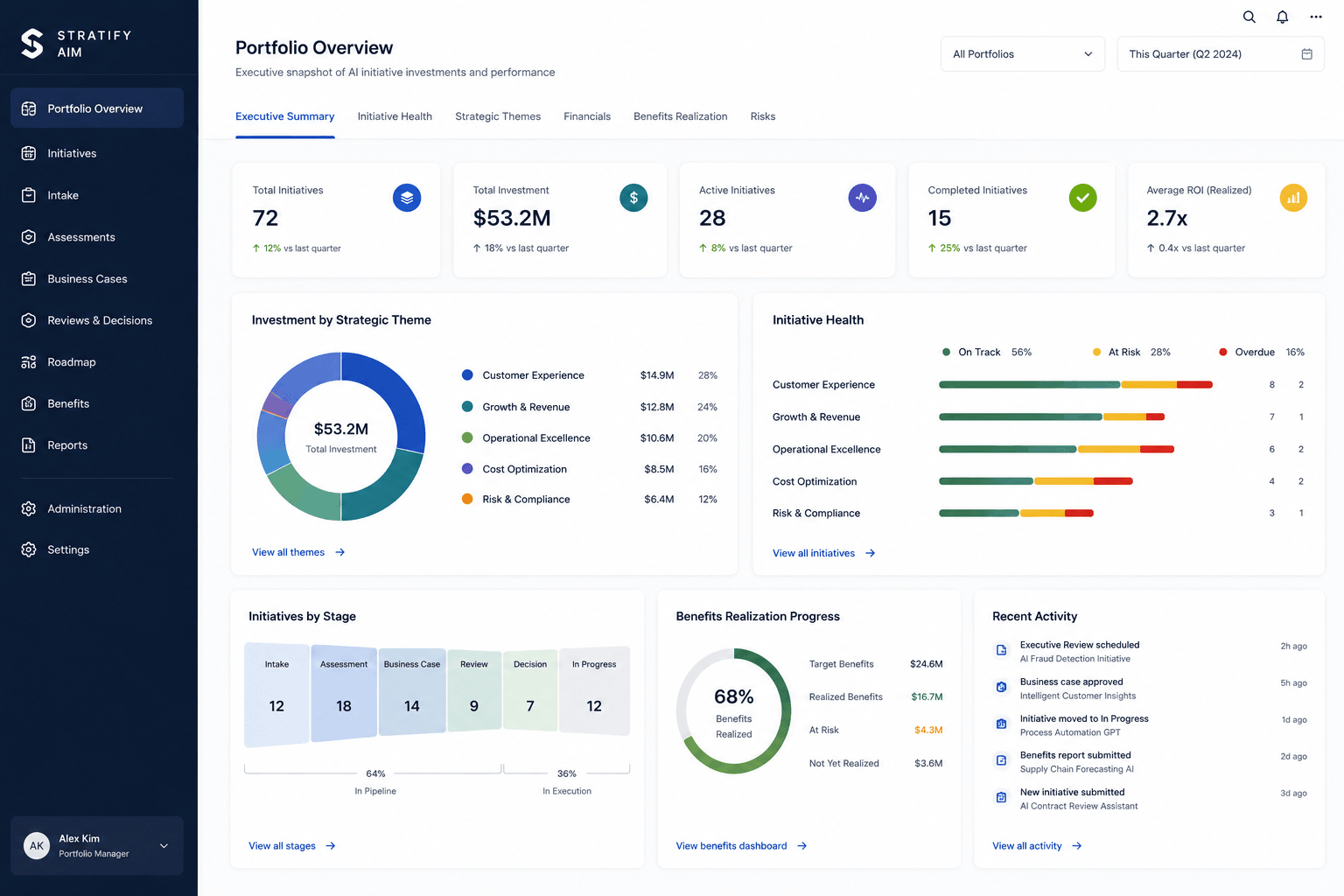
Flow makes the work legible. AIM decides what to do about it.
Stratify AIM came first. To govern AI investment properly, we needed structured intake, evidence-backed decisions, approvals, state, outcomes, and a complete history behind every initiative.
Building AIM required an engine for structured work. That engine turned out to solve a much larger problem. Flow applies it to the operational processes companies run every day.
The two now reinforce each other. Flow produces operational evidence. That evidence reveals where automation and AI can create value. AIM governs which investments the company chooses to make, and whether that value actually arrives.
One engine. Two problems. One operating model.
Not another layer on top of broken work.
- Operate
- Measure
- Improve
- Automate
- Govern
Start with the process that hurts most.
Not everything. The one where things get lost, where status is a question rather than a fact, or where everyone knows the spreadsheet isn't good enough, but replacing it has never been worth the project.
Show us that one.