Research Report
Published · Updated
[New 2026 Data]
Download the full 34-page benchmark — 70% structural failure stats, Failure Stack, and Authorization Matrix (free).
Free • Includes 70% Structural Failure Stat + Authorization Matrix
Download the Full 2026 AI Capital Risk Benchmark Report70% of Enterprise AI Projects Fail for Structural Reasons – New 2026 Benchmark Report
New 2026 benchmark: download the free report if you need board-ready evidence that roughly 70% of enterprise AI deployment failures trace to structural exposure—not model quality alone—and that about half of organizations land in Controlled Investment before scale capital is approved.
Structural patterns influencing enterprise AI deployment outcomes
AI Capital Risk is the risk of approving AI investment before an organization is ready to deploy it at scale, resulting in potential capital impairment.
This page is designed as a decision pathway for leaders evaluating whether promising AI pilots justify scaled deployment capital, and when a short brief, fuller report, or conversation is the right next step.
Recommended first step
Looking for the detailed research edition? Access the full benchmark report.
AI pilots are succeeding. Scaling often stalls.
Many organizations demonstrate strong AI pilot results, yet struggle to translate early success into durable enterprise deployment capability.
Structural conditions such as governance continuity, execution ownership, infrastructure reliability, regulatory preparedness, and capital discipline often determine whether AI investment scales successfully.
AI Capital Risk describes the exposure created when deployment capital is authorized before these structural conditions are sufficiently mature. Benchmark synthesis indicates that structural factors appear linked to a majority of enterprise AI deployment failures.
Primary asset
Download 2-page briefIntroduces AI Capital Risk and the structural patterns observed across enterprise AI deployment decisions.
When this research is most relevant
This brief may be useful if:
- your organization has multiple AI pilots underway
- leadership is deciding which AI initiatives should scale
- AI investment decisions exceed approximately $500k-$1M
- governance structures are still evolving
- AI initiatives show promise but scaling feels uncertain
- teams are evaluating EU AI Act or related regulatory exposure
- boards are asking for clearer AI investment rationale
- multiple AI initiatives are competing for funding
Recommended first step
Start with the 5-minute overview
The 2-page brief introduces the structural patterns observed across enterprise AI deployment decisions.
- why pilot success often precedes structural durability
- why many organizations fall into a Controlled Investment posture
- a decision logic for determining when AI investment should scale
Why AI Capital Risk Is a Distinct Category
AI Capital Risk is not a generic readiness score or a model-risk label. It is a capital-authorization category focused on whether deployment capital should be approved under current structural conditions.
- Pilot evidence can validate technical feasibility without establishing deployment fitness.
- Capital timing errors appear when deployment spend is scaled before structural conditions stabilize.
- The category exists to answer whether deployment capital should be authorized now, not whether AI adoption is generally progressing.
AI Readiness
Asks whether an organization can adopt AI capabilities. It does not directly answer whether deployment capital should be authorized now.
AI Governance
Defines controls and oversight structures. It informs authorization, but does not itself produce a capital posture.
AI Risk Assessment
Typically evaluates model, privacy, security, or compliance issues. It often misses deployment timing and capital discipline.
AI Capital Risk
Determines whether deployment capital should be paused, constrained, or authorized based on structural readiness evidence.
Read the category comparison: AI Capital Risk vs AI Readiness →
What This Benchmark Is Not
This benchmark provides directional signals about structural exposure and capital authorization quality. It should not be interpreted as a universal AI scorecard.
- not a model benchmarking study
- not a generic AI readiness framework
- not a compliance checklist
- not a vendor market map
- not a census of all enterprise AI deployments
What the benchmark examines
- 120+ enterprise AI deployment evaluations
- 40+ AI capital authorization reviews
- organizations across 15 industries
- deployments across North America and Europe
The benchmark synthesizes recurring structural patterns observed across enterprise AI deployment contexts rather than reporting results from a single survey dataset.
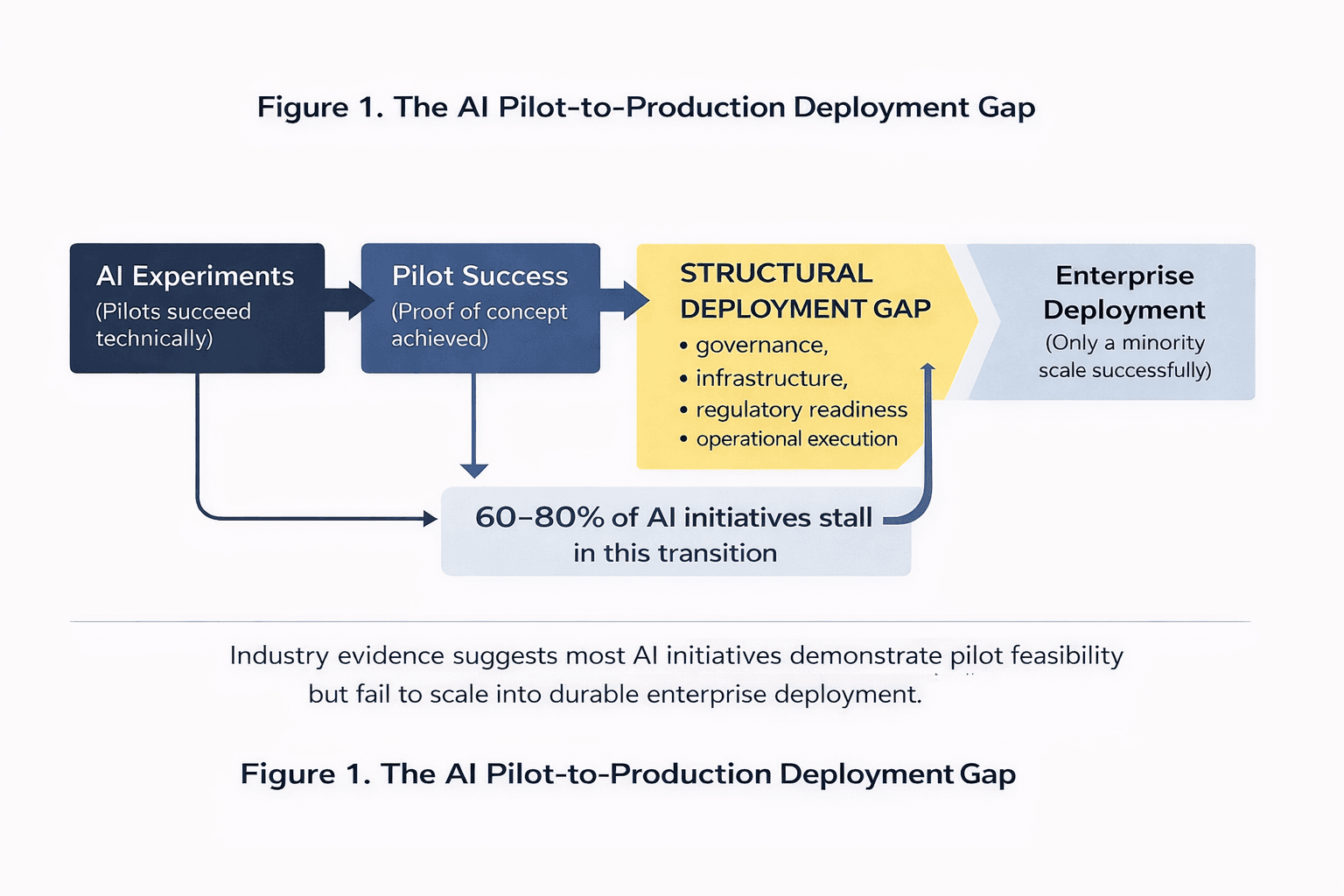
Figure 1. The AI Pilot-to-Production Gap

Pilot feasibility validates technical potential. Enterprise deployment requires structural maturity across governance, regulation, infrastructure, and execution.
The gap between those timelines explains why pilot evidence often precedes organization-wide readiness and why capital can be authorized too early.
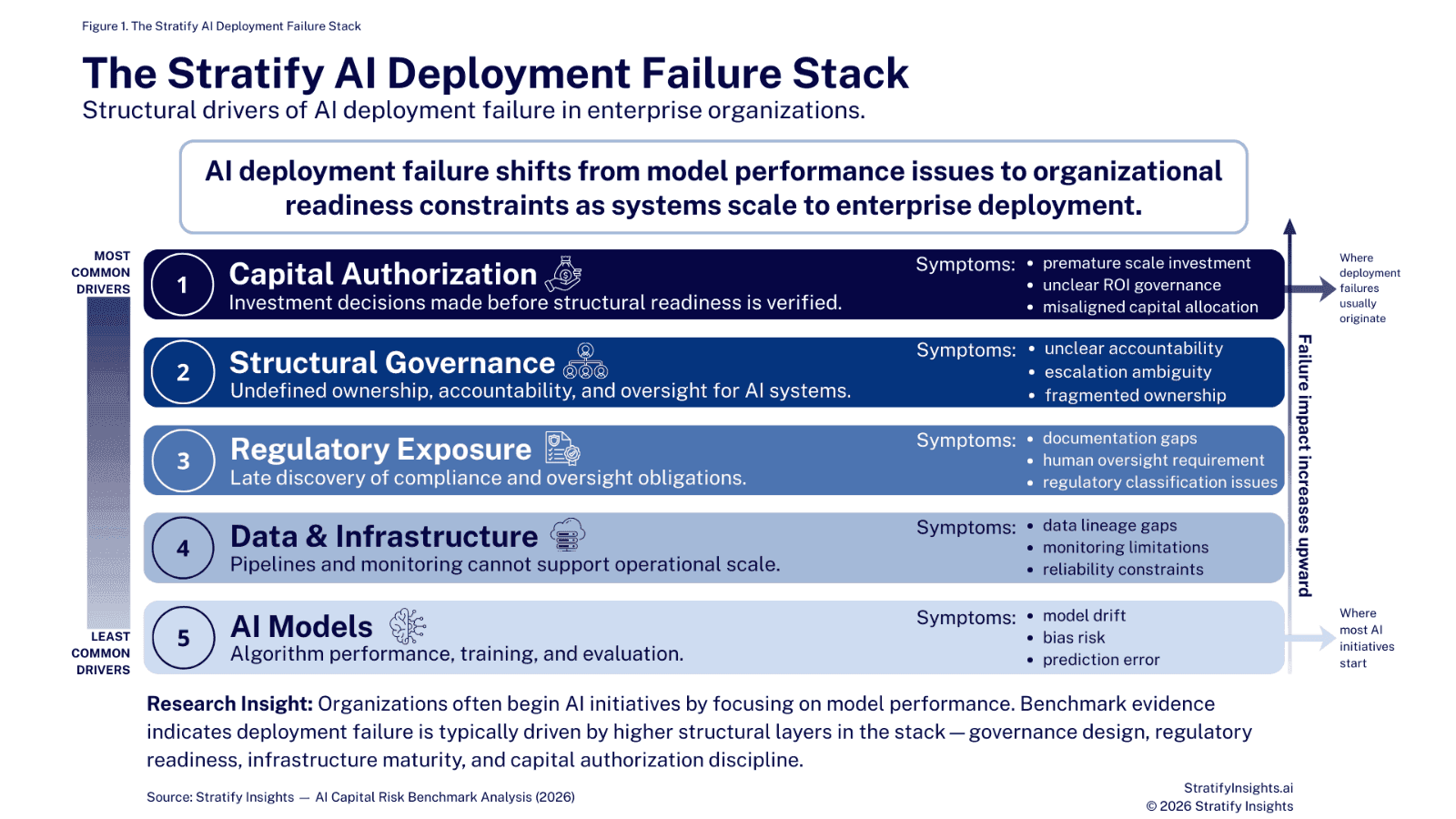
Figure 2. The Stratify AI Deployment Failure Stack

Structural constraints dominate scaling outcomes more often than model performance alone. Governance continuity, authorization clarity, monitoring responsibility, and capital discipline frequently determine whether AI investments reach durable production scale.
Key benchmark observations
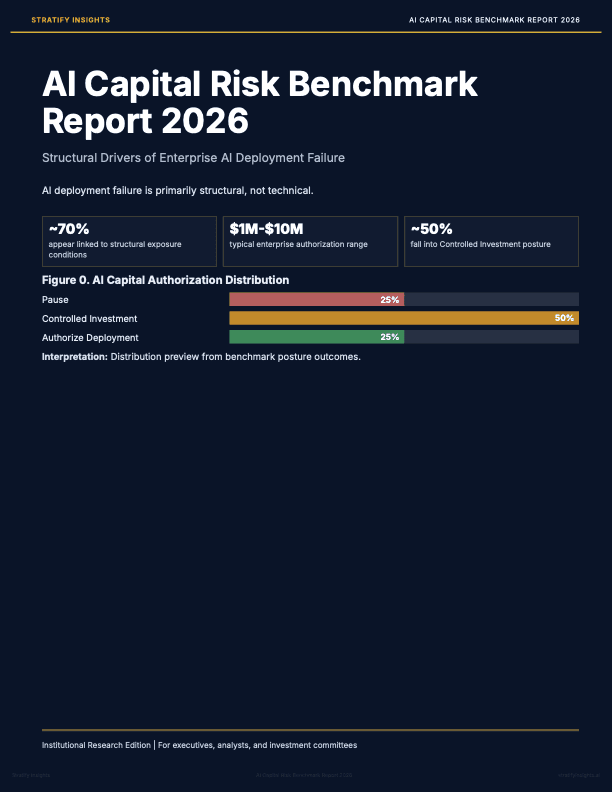
- Approximately 70% of AI deployment failures appear linked to structural exposure conditions.
- Governance accountability gaps appear in roughly 68% of enterprise deployments.
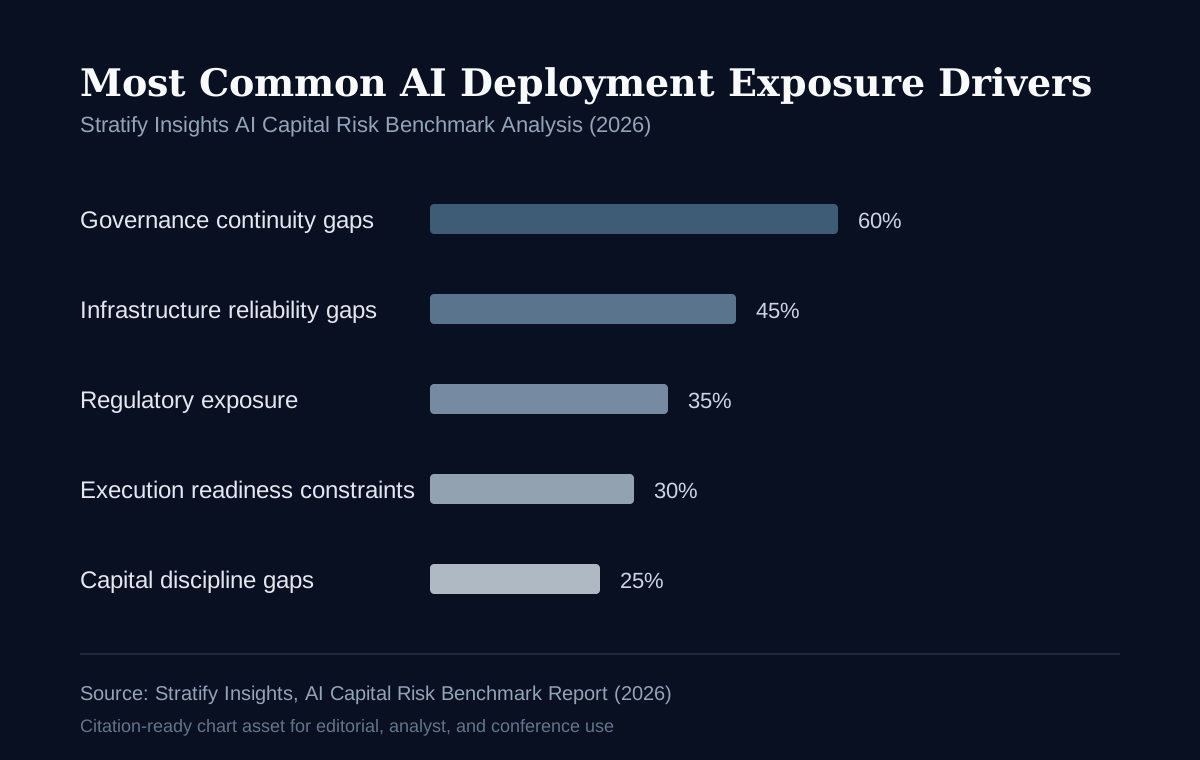
- Infrastructure fragility constrains scaling in approximately 45% of organizations.
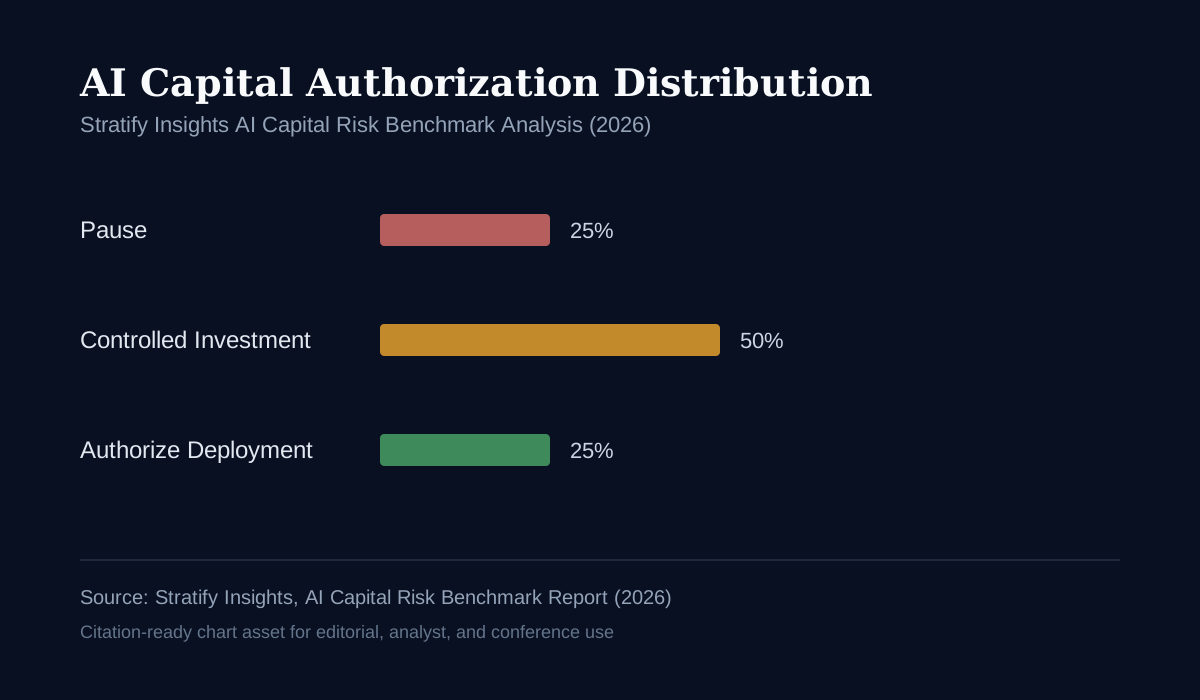
- Roughly 50% of organizations fall into a Controlled Investment authorization posture.
- Approximately 25% require Pause authorization before scaling.
- Most enterprise AI deployment capital commitments fall within the $1M-$10M range.
Figure 3
AI Capital Authorization Distribution
Source: Stratify Insights AI Capital Risk Benchmark Analysis (2026)
Figure 4
Most Common AI Deployment Exposure Drivers
Source: Stratify Insights AI Capital Risk Benchmark Analysis (2026)
These signals should be read as directional benchmark evidence indicating that organizational readiness governs deployment durability once enterprises move from pilot experimentation to capital authorization.
Observable Indicators of AI Capital Risk
Unclear production accountability owner
Governance continuity has not yet been established across business, technology, and risk functions.
Fragmented approval authority
Capital, deployment, and control decisions are still being made through disconnected approval processes.
Governance roles defined after deployment
Oversight structures are being retrofitted rather than built before scale capital is committed.
Pilot success depends on manual intervention
The operating model has not matured enough for durable enterprise deployment conditions.
Monitoring responsibility is unclear
No stable run-state owner exists for model oversight, incident response, and ongoing accountability.
Deployment decisions lack defined authorization criteria
Capital discipline logic has not yet been formalized into an explicit deployment posture.
Observable indicators provide early signals of underlying structural exposure before deployment failure becomes visible in operating results.
Authorization Posture Logic
The benchmark becomes decision-relevant when structural evidence is translated into a capital authorization posture.
Pause
Deployment capital should not be authorized until structural conditions are remediated.
Controlled Investment
Deployment may proceed under explicit governance and operational guardrails while structural maturity improves.
Authorize Deployment
Structural evidence supports broader scale under ongoing governance oversight.
Authorization quality depends on structural maturity, not executive optimism. This is the bridge from benchmark evidence to board-level decision logic.
Signature Visual
AI Capital Authorization Matrix
The matrix translates benchmark logic into a simple decision model: structural readiness and capital exposure together determine whether AI deployment should be paused, constrained, or authorized.
Compare observations
We are discussing these structural patterns with a small group of technology leaders evaluating AI investment decisions.
If useful, we are happy to:
- compare structural observations across organizations
- share anonymized benchmark patterns
- discuss where pilot success often diverges from deployment readiness
- provide a preview of evaluation logic
From Research to Evaluation
The benchmark research informs the AI Capital Risk Framework, which in turn is operationalized through the AI Capital Risk Instrument (ACRI).
ACRI evaluates structural exposure across five vectors, produces a posture output of Pause, Controlled Investment, or Authorize Deployment, and delivers the result in a board-ready report.
Review a sample AI Capital Risk Report or read the benchmark methodology note.
Full benchmark report (30 pages)
The full benchmark report provides detailed structural analysis, maturity model logic, authorization posture methodology, and illustrative enterprise scenarios.

Institutional Edition • Published 2026 • Research preview
Media & Citation Kit
Quotable Insights
- "Approximately 70% of AI deployment failures appear linked to structural exposure conditions."
- "When structural exposure is evaluated, roughly 50% of organizations fall into a Controlled Investment authorization posture."
- "Most enterprise AI deployments occur within the $1M-$10M capital authorization range."
Suggested Citation
Stratify Insights. AI Capital Risk Benchmark Report: Structural Drivers of Enterprise AI Deployment Failure. 2026.
Need the consolidated resource set? Open the Press & Citation Kit →
Embeddable Chart and Visual Assets
AI Capital Authorization Distribution
Download SVG chartMost Common AI Deployment Exposure Drivers
Download SVG chartThe AI Deployment Failure Stack
Download SVG visualAI Capital Authorization Matrix
Download SVG visualUse with citation: Stratify Insights, AI Capital Risk Benchmark Report (2026).
Press Contact
research@stratifyinsights.aiResearch Authority and Methodology
- 120+ enterprise AI deployment evaluations
- 40+ AI capital authorization reviews
- organizations across 15 industries
- deployments across North America and Europe
This benchmark synthesizes recurring structural patterns observed across enterprise AI deployment environments and external adoption research rather than reporting results from a single survey dataset.
Research context draws on institutional studies from Stanford HAI, McKinsey, Boston Consulting Group, MIT Sloan Management Review, and related institutions studying enterprise AI adoption.
Benchmark Report FAQ
What does the AI Capital Risk Benchmark Report measure?
The benchmark report synthesizes structural exposure patterns observed across enterprise AI deployments and translates them into directional evidence about authorization posture, exposure drivers, and deployment failure conditions.
Does the benchmark report explain why AI projects fail after pilot?
Yes. A core benchmark conclusion is that many AI initiatives stall after pilot because structural conditions such as governance continuity, infrastructure reliability, regulatory readiness, and capital discipline lag behind technical feasibility.
How should executives use the AI Capital Risk Benchmark Report?
Executives should use the benchmark as a research layer to understand whether deployment capital is being authorized too early and to interpret structural signals before relying on pilot success as evidence of enterprise readiness.
How does the benchmark connect to the AI Capital Risk Instrument (ACRI)?
The benchmark provides the analytical foundation for the AI Capital Risk Framework and the AI Capital Risk Instrument (ACRI), which operationalizes those structural patterns into a deterministic capital authorization posture.
Optional: quick exposure signal
A short diagnostic indicating whether structural AI capital exposure signals may be present.
Estimated completion time: approximately 60 seconds.
Related resources: AI Capital Risk · AI Capital Risk Framework · AI Capital Risk Instrument (ACRI) · Benchmark Methodology Note
Typical situations where organizations evaluate AI Capital Risk
- preparing to scale successful AI pilots
- prioritizing among multiple AI initiatives
- allocating AI transformation capital
- defining governance before production deployment
- evaluating regulatory exposure such as EU AI Act or NIST AI RMF alignment
- preparing board-level AI investment decisions
- standardizing AI risk evaluation across portfolio companies
Related research
Continue with the Stratify research index for methodology notes, maturity models, and governance frameworks—or jump to the highest-signal pages below.
AI Project Failure Rate (Structural Signal)
Research-backed view of why ~70% of enterprise AI deployment failures trace to structural exposure—not model quality alone—with links to the free PDF.
Explore the failure-rate analysis →