Stratify Research | Benchmark Brief (2026)
AI pilots often create confidence before deployment readiness is tested.Scaling is where structural failure becomes visible.
Across enterprise programs, early results often create confidence and unlock capital before operating load has been tested. Friction appears later when governance, ownership, and execution structures lag the investment already committed.
Most organizations only recognize this after capital has already been committed.
See your authorization posture before committing capital
We consistently see the same sequence
This is where risk concentrates.
The earlier you identify it, the more optionality you retain.
The pattern we're seeing
Most organizations do not fail AI at the pilot stage.
They stall when capital, scope, and operating pressure increase faster than structural readiness - where governance, data, execution, and capital discipline must hold under real load.
This is where risk concentrates.
Where they often land
Controlled Investment
Deployment continues, not model readiness. Scaling is limited until structural gaps are addressed.
Most organizations remain in this state longer than expected - continuing to invest without resolving the constraints that limit scale.
Why this matters
Scaling too early doesn't fail technically.It fails financially.
- Capital is committed before the organization is ready
- ROI is delayed by rework and re-scoping
- Execution breaks under real operating load
By the time failure becomes visible, capital has already been deployed.
What creates the gap
The issue is not technical.It is structural.
Across programs, five areas consistently determine whether scaling succeeds or fails:
- Governance and decision ownership
- Regulatory and compliance exposure
- Data and infrastructure reliability
- Cross-functional execution alignment
- Capital discipline and ROI tracking
When these lag behind investment, execution breaks.
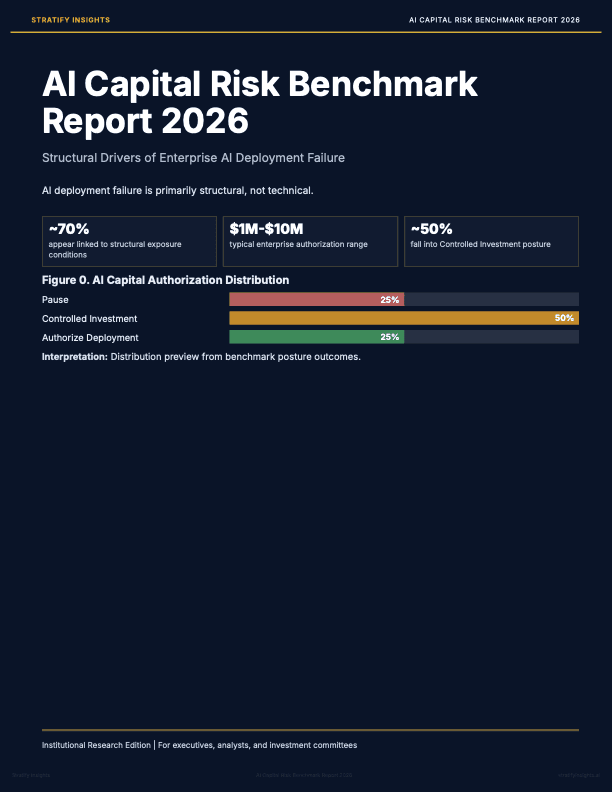
Download the executive benchmark brief
For a deeper view of these patterns, download the full executive brief.
The brief provides a concise, research-backed summary of:
The AI Pilot-to-Production Gap
Structural signals that determine deployment readiness
The five vectors of AI Capital Risk
The Capital Authorization Framework (Pause, Controlled Investment, Authorize Deployment)
Benchmark observations across enterprise AI initiatives
PDF • 16 pages • Executive summary • Board-ready
The decision most teams get wrong
Most organizations don't fail because they chose the wrong use case.They fail because they scaled at the wrong time.
Pilot success is often treated as justification for deployment - when in reality, it is only an indicator of technical capability.
Capital authorization is a structural decision.
Before you commit further capital, know your posture
This diagnostic answers one question:Should this initiative scale now, scale with constraints, or pause?
Strong pilots do not, by themselves, prove that structure can carry the next tranche. The AI Capital Risk Diagnostic gives a clear answer on whether to scale now, with constraints, or pause - with capital-backed confidence.
See your authorization posture before committing capital
What this diagnostic reveals
Most organizations are already exposed - they just haven't measured it yet.
Your Capital Authorization Posture (Pause, Controlled Investment, Authorize Deployment)
AI Capital Risk Index (ACRI)
The 2–3 structural constraints most likely to stall scaling
Clear operational and financial implications
Prioritized next steps
All outputs are delivered in concise, board-ready language.
The question is not
“Why do AI projects fail?”
The real question is
“Should this initiative scale right now?”
See your authorization posture before committing capital
Interested in the full benchmark, dataset, and analysis?
View the full benchmark report →