Research report
70% of Enterprise AI Projects Fail for Structural Reasons— New 2026 Benchmark Report
The evidence points to a deployment readiness problem: structural conditions—not technical capability—govern whether AI scales. This report draws on 200+ enterprise programs and $2B+ in observed capital decisions.
200+
Enterprise AI programs
$2B+
In deployed capital decisions
12
Industries represented
2024–2026
Data collection period
No registration required. Instant download.
Key takeaway
AI projects don't fail because the technology doesn't work. They fail because organizations scale before their structure is ready.
This is a capital sequencing problem, not a model performance problem.
The cost of getting this wrong
- Average cost of a stalled AI initiative$5.2M
- Average time to recognize failure9–14 months
- Percent of initiatives requiring recapitalization68%
70%
structural
of AI project failures are tied to structural conditions—not model quality alone.
Why scaling stalls
Under real operating load, friction shows up in governance, data, execution, and capital discipline. When those structures lag, deployment still happens—but it doesn't hold.
The report maps where that gap typically appears, and what boards need to see before the next tranche of capital. For the underlying analysis, see the AI failure rate research.
What this report will help you answer
- What structural conditions most often cause post-pilot failure
- How your authorization posture compares to observed peer benchmarks
- Whether capital is being sequenced ahead of deployment readiness
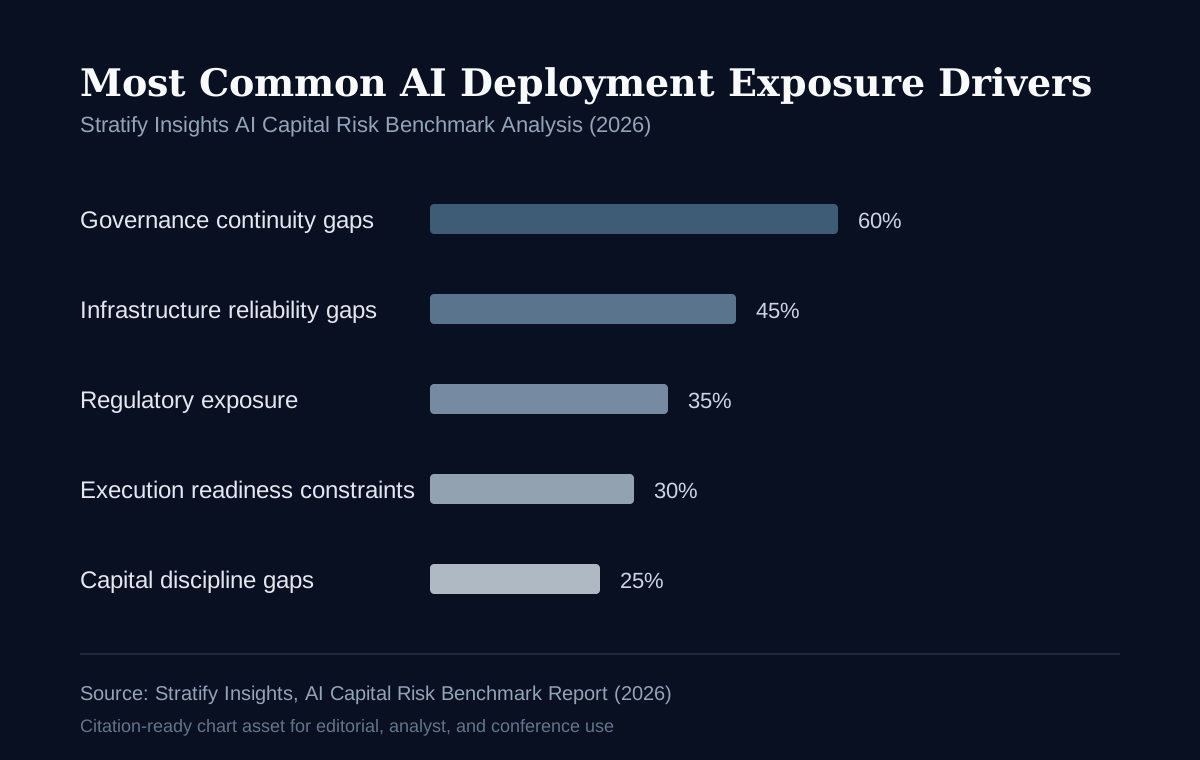
- Which exposure drivers are most material in enterprise contexts
- How to frame deployment and capital decisions for boards and risk committees
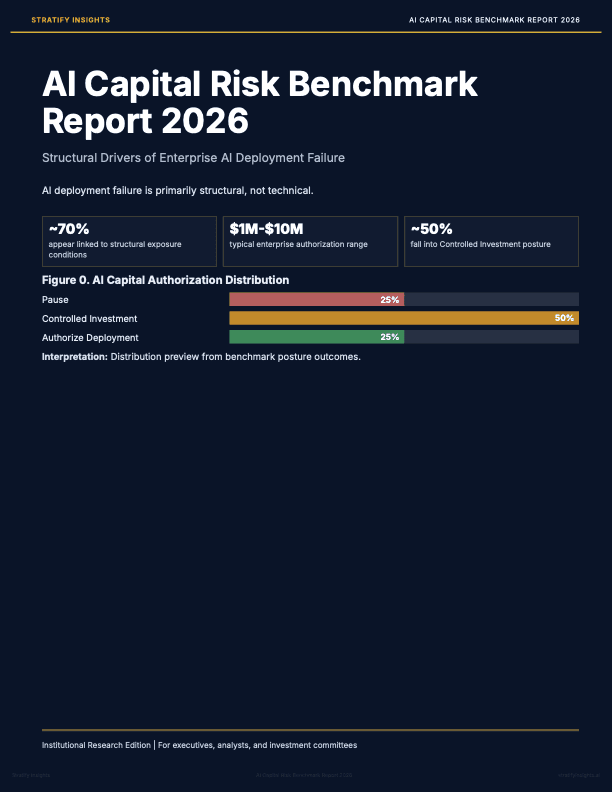
Start with the 5-minute overview
The executive brief distills the benchmark story.
- • Key 70% structural failure statistic
- • Failure Stack and driver patterns
- • Capital Authorization Framework (Pause, Controlled Investment, Authorize)
5 minutes to read
Why AI Capital Risk is a distinct category
It answers whether deployment capital should be authorized now—not whether AI adoption is generally progressing.
Structural, Not Technical
AI Capital Risk is about governance, data, execution, and capital discipline under load—not model accuracy alone.
Cross-Functional Impact
Failure modes span business, technology, risk, and finance. The benchmark encodes that cross-boundary pattern.
Capital Sequencing Risk
The core failure is often timing: scale capital before structure can carry it, not a lack of early pilot wins.
Observable Patterns
Authorization gaps, manual run-state, and unclear ownership show up as repeatable signal—not one-off project noise.
Measurable & Actionable
The report translates patterns into a posture read (Pause, Controlled Investment, Authorize) and prioritized focus.
Board-Relevant
Outputs are framed in concise, defensible language suitable for investment and oversight conversations.
Visual evidence from the report
Figure 1
The AI Pilot-to-Production Gap
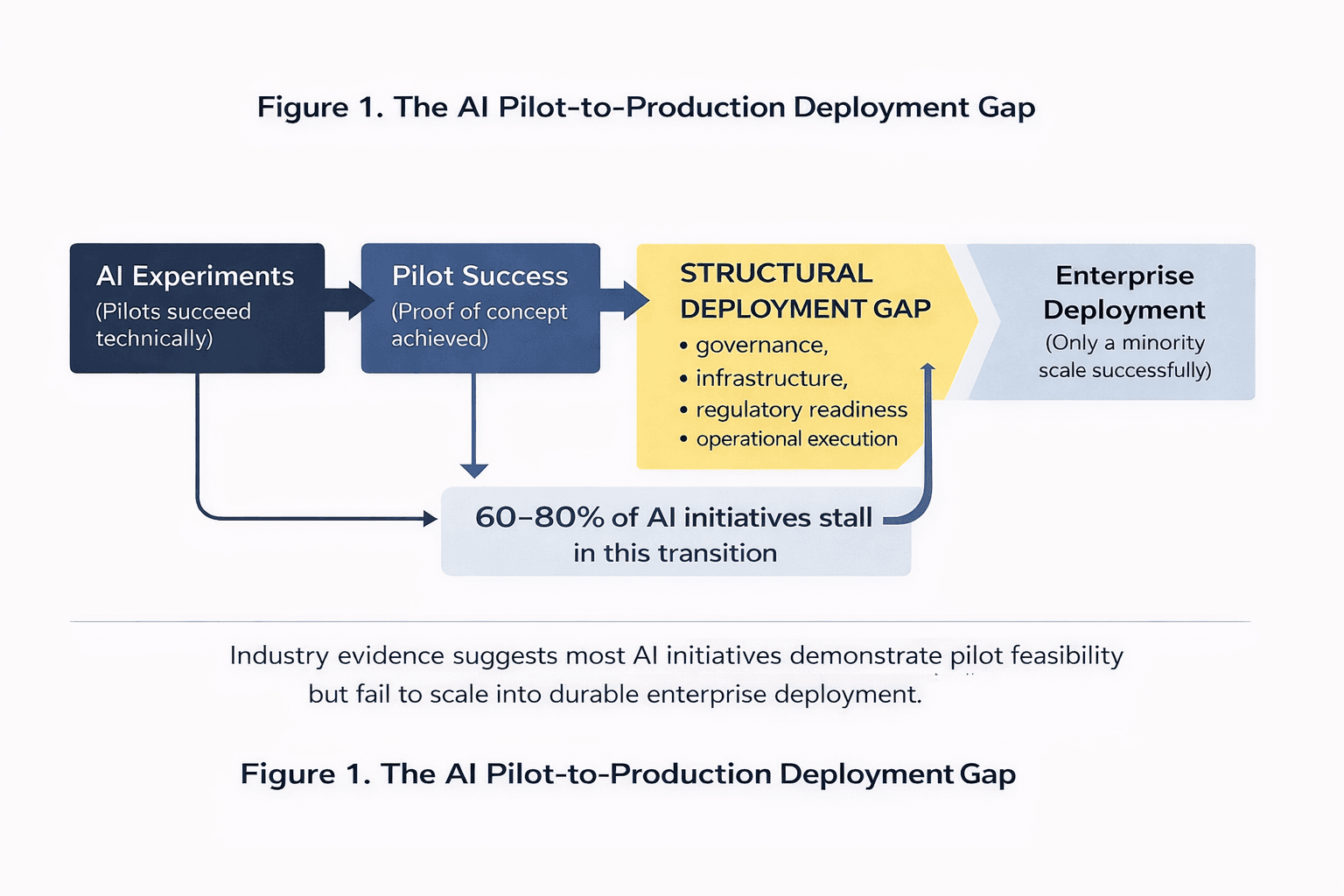
Figure 2
The AI Deployment Failure Stack
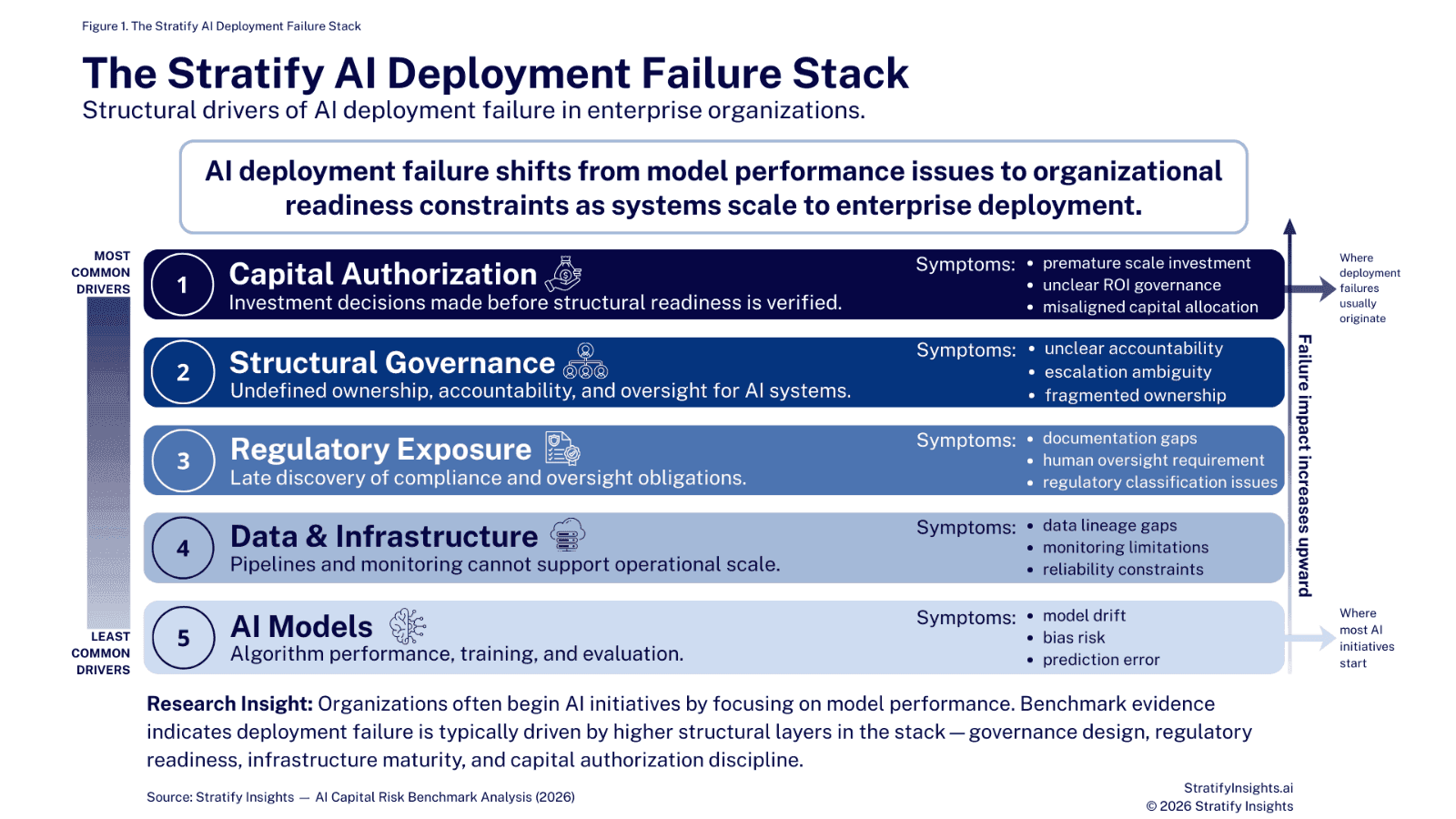
Figure 3
Key benchmark observations
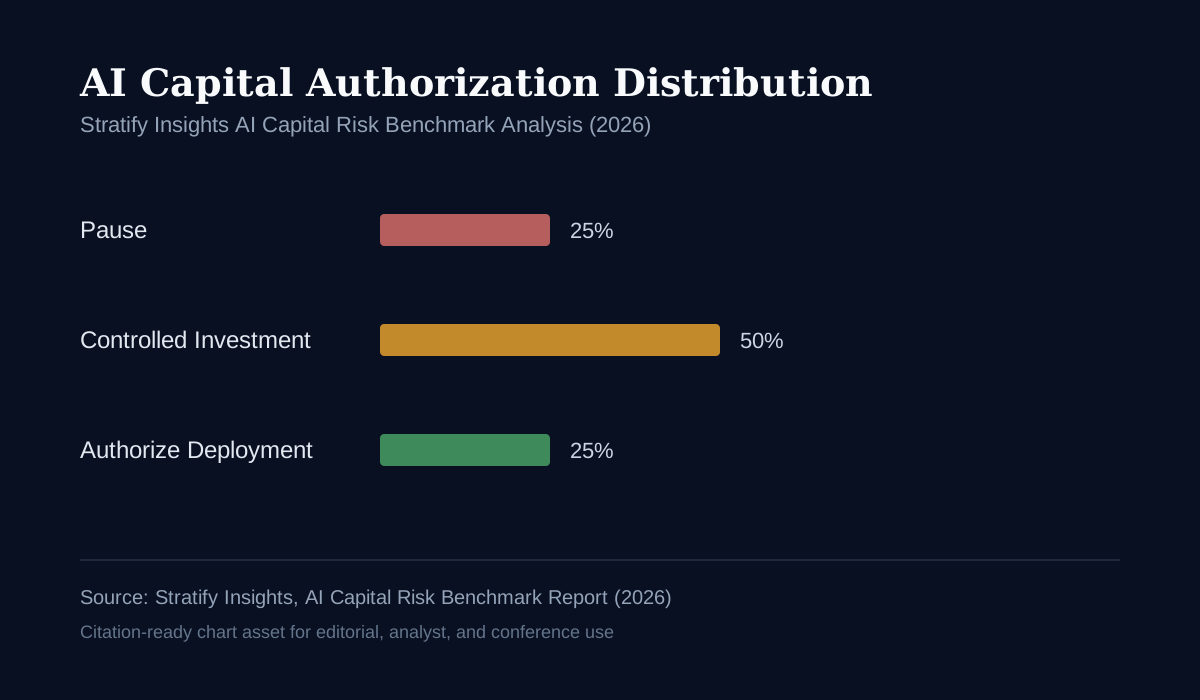
Figure 4
Most common exposure drivers
Make better capital decisions
- Reduce timing risk from scaling before structure is ready
- Tighten governance and ownership clarity before the next tranche
- Increase the odds of durable production outcomes—not just successful pilots
Not sure where your organization stands?
The AI Capital Authorization Diagnostic translates structural signals into a clear authorization posture and next step—before the next round of capital.
See your authorization posture before committing capital.
Confidential • No obligation • Delivered through a focused working session with your leadership team
What's inside
Comprehensive Data
Structural Framework
Benchmark Analysis
Authorization Framework
Actionable Guidance
Good data changes the conversation. Better structure changes the outcome.
No registration required. Instant download.
For methodology, see the benchmark methodology note · Press and citations: Press & Citation Kit
Benchmark report FAQ
What does the AI Capital Authorization Benchmark Report measure?
The benchmark report synthesizes structural exposure patterns observed across enterprise AI deployments and translates them into directional evidence about authorization posture, exposure drivers, and deployment failure conditions.
Does the benchmark report explain why AI projects fail after pilot?
Yes. A core benchmark conclusion is that many AI initiatives stall after pilot because structural conditions such as governance continuity, infrastructure reliability, regulatory readiness, and capital discipline lag behind technical feasibility.
How should executives use the AI Capital Authorization Benchmark Report?
Executives should use the benchmark as a research layer to understand whether deployment capital is being authorized too early and to interpret structural signals before relying on pilot success as evidence of enterprise readiness.
How does the benchmark connect to the AI Capital Authorization Instrument (ACRI)?
The benchmark provides the analytical foundation for the AI Capital Authorization Framework and the AI Capital Authorization Instrument (ACRI), which operationalizes those structural patterns into a deterministic capital authorization posture.
Related research
Continue with the Stratify research index for methodology notes, maturity models, and governance frameworks—or jump to the highest-signal pages below.
AI Project Failure Rate (Structural Signal)
Research-backed view of why ~70% of enterprise AI deployment failures trace to structural exposure—not model quality alone—with links to the free PDF.
Explore the failure-rate analysis →